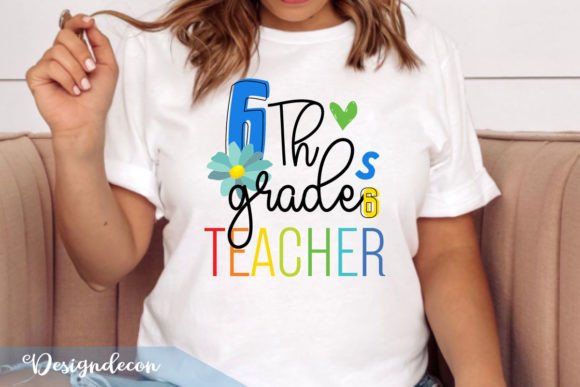
6th Grade Teacher Retro Sublimation Png Review
As a designer who bridges the gap between digital graphics and physical thread, I approach every new asset with a specific question: will this actually stitch out well? When evaluating the 6th Grade Teacher Retro Sublimation Png, my first impression is that it captures a very specific, nostalgic aesthetic that is currently dominating the teacher apparel market. The retro vibe suggests bold typography, groovy color palettes, and a layout that feels vintage yet fresh. However, as an embroidery professional, I know that what looks seamless on a screen requires careful translation to become a successful machine embroidery design. This review breaks down how this graphic performs when moved from a digital download to a tangible handmade product.
Translating Retro Graphics to Stitch Reality
The 6th Grade Teacher Retro Sublimation Png is marketed primarily for sublimation, which means it is optimized for ink transfer rather than needle penetration. For us in the embroidery world, this distinction matters. Retro designs often feature distressed textures or gradient shading that cannot be replicated with standard thread. When I look at this file, I see a strong candidate for an applique design rather than a full-coverage fill. The bold shapes typical of 6th-grade retro themes provide excellent boundaries for fabric placement, allowing the texture of the chosen material to add depth that ink simply cannot achieve.
If you intend to digitize this yourself or hire a digitizer, focus on simplifying the internal details. A satin stitch border works beautifully to define the retro lettering, while a light fill stitch can anchor larger background elements without creating a bulletproof patch. Because the source file includes vector formats like EPS and SVG, you have clean lines to trace, which is crucial for maintaining crisp edges in your embroidery file. Always verify that the "easy to color change" claim applies to distinct vector layers; merged raster layers make digitizing significantly harder and less precise.
Real-World Application: The Middle School Sweatshirt Test
To truly judge this design, I mentally placed it in a real production scenario: creating custom crewneck sweatshirts for a middle school teacher appreciation event. Sixth grade is a transitional year, and teachers often want merchandise that feels mature yet fun. The 6th Grade Teacher Retro Sublimation Png fits this demographic perfectly, avoiding the overly cutesy style of elementary grades while remaining approachable.
For this sweatshirt embroidery project, the design’s size is critical. At 3600x3600 pixels, the resolution is sufficient for digitizing reference, but the physical scale must be adjusted for wearability. On a unisex adult sweatshirt, a center-chest placement of roughly 9 to 10 inches wide allows the retro font to remain legible from a distance. I would pair this with a high-quality tear-away stabilizer and perhaps a fusible mesh backing to prevent the heavy fleece from distorting under the stitch density required for retro block letters. The result is a custom apparel piece that feels boutique-ready rather than homemade, increasing its perceived value for both the wearer and potential buyers if you are an Etsy seller.
Navigating Fabric Limitations and Hoop Constraints
While the aesthetic is versatile, not every surface welcomes this type of design. Retro graphics rely on visual weight, which can overwhelm delicate materials. I would advise against using this specific digital embroidery file on lightweight baby clothes or sheer fabrics unless you drastically reduce the size and simplify the stitch count. The density needed to render retro text clearly could cause puckering or even damage thin weaves. Instead, reserve this design for stable, medium-to-heavyweight fabrics like canvas tote bags, denim jackets, or structured caps.
Speaking of caps, curved surfaces present unique challenges for retro layouts. If the 6th Grade Teacher Retro Sublimation Png features arched text, ensure your digitizing software accounts for the cap's curvature to prevent distortion. For flat items like a tote bag design or tea towel, you have more freedom, but you must still watch your hoop size. Large retro designs often push the limits of standard hoops. If you lack a jumbo hoop, consider splitting the design into two parts or resizing it to fit comfortably within your machine’s maximum field. Never force a design into a hoop that is too small; the tension issues will ruin the registration and waste your time.
Commercial Viability and Professional Presentation
For creative entrepreneurs and small shop product developers, this graphic offers significant commercial potential, provided you handle the licensing correctly. Before listing any finished product for sale, confirm whether your purchase includes commercial rights for embroidered goods. Some licenses cover digital use but exclude physical merchandise. Assuming you are cleared for commercial embroidery, this design is a strong contender for seasonal sales. Teachers love personalized gifts, and a retro-styled item stands out in a sea of generic monograms.
Your marketing assets matter just as much as the stitching. Since mockups and preview images are noted as exclusions in the product description, you must create your own. Do not rely solely on digital renders. Stitch out a sample on the actual fabric you intend to sell, then photograph it in natural light. A real photo builds customer trust far better than a sterile printable mockup. Show the texture of the thread, the sheen of the rayon or polyester, and how the design interacts with the fabric grain. This transparency reduces returns and sets realistic expectations for buyers seeking a genuine personalized gift.
Essential Designer Notes for Success
Before you commit thread to fabric, run through this practical checklist to ensure the 6th Grade Teacher Retro Sublimation Png translates successfully:
- Test on Scrap Fabric: Never start on the final garment. Use a similar weight scrap to check tension, density, and color contrast.
- Verify Vector Integrity: Open the EPS/SVG file to ensure paths are closed and nodes are clean before importing into digitizing software.
- Check Thread Colors: Retro palettes often use muted tones. Verify you have exact thread matches or suitable alternatives before starting.
- Assess Small Details: If the design has tiny accent elements, determine if they can be rendered with a running stitch or if they should be omitted entirely to maintain clarity.
- Stabilizer Selection: Match your stabilizer to the fabric, not just the design. Heavy retro stitches on knit fabrics require cutaway support.
- Licensing Confirmation: Double-check terms for both selling physical items and using the design in digital marketing materials.
- Black and White Test: View the digitized file in grayscale to ensure contrast relies on stitch direction and texture, not just color differences.
Ultimately, the 6th Grade Teacher Retro Sublimation Png is a valuable asset for makers willing to adapt it thoughtfully. It brings a trendy, emotional connection to Graphics in the education niche, but its success in embroidery depends entirely on your technical execution. By respecting the limitations of thread and fabric, and by leveraging the vector scalability for clean digitizing, you can transform this digital download into a premium embroidery project that delights teachers and strengthens your brand reputation. Remember, in our industry, the best design is one that looks as good after 50 washes as it did coming off the hoop.